

On Making Words - The Lexicon
The Dictionary of Rajheshian Words

On Making Words, in three parts: The Essay · The Method · The Lexicon (you are here)
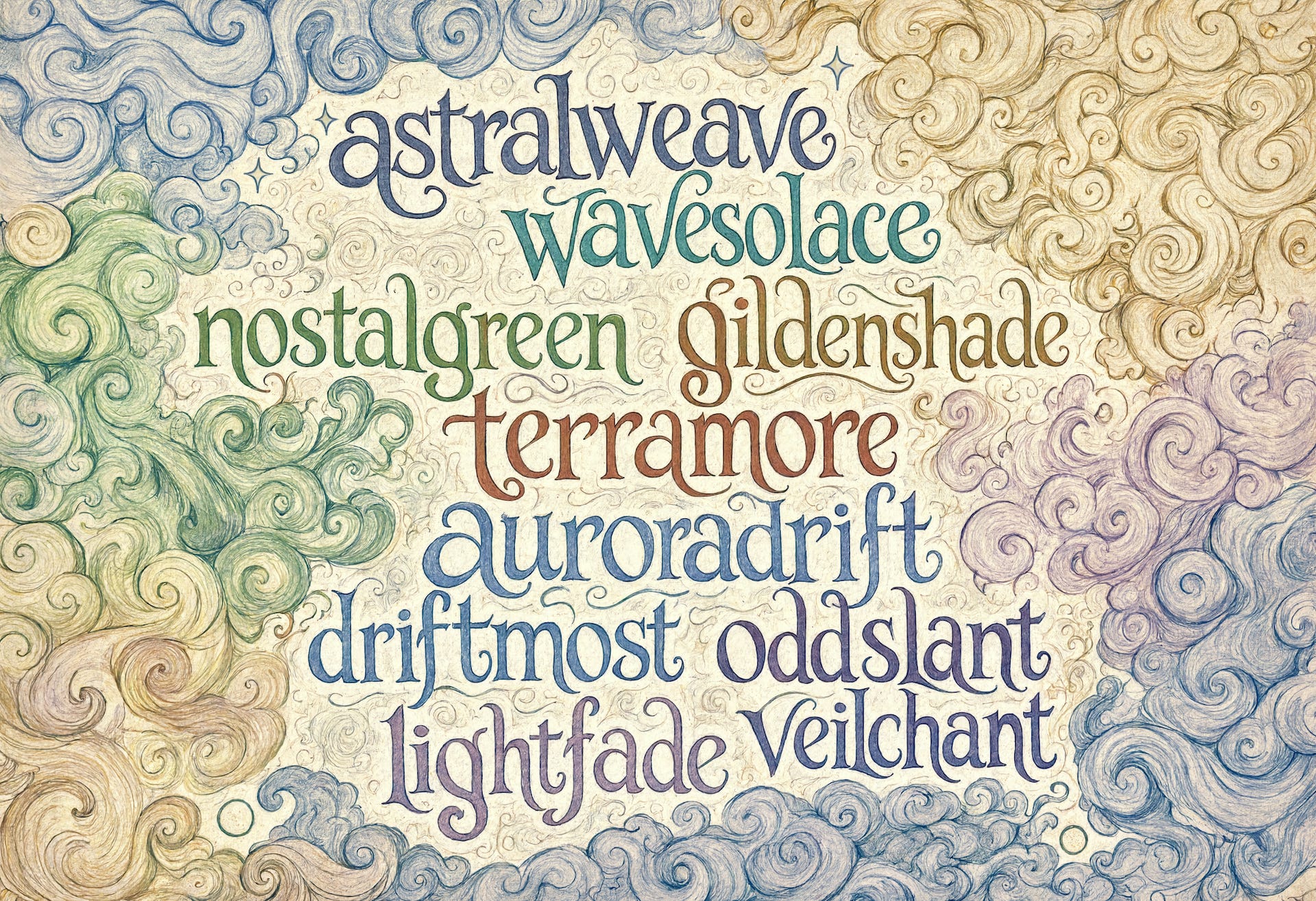
Companion to On Making Words — the essay on where these came from. A living lexicon: new words are still coined the same way, two existing words fused into one. The five River Celestial album titles are marked ★.*
A
Absoluvit (adjective)
Meaning: a state of absolute love or approval
Usage: “That album? Absoluvit.”
Origin: Latin absolutus “set free, complete” → French absolu, with coined suffix -vit
Mood: adoring, emphatic
Astralweave ★ (noun)
Meaning: the intertwining of dreams, stars, memories, and destiny
Usage: “The night sky pulled them into its astralweave.”
Origin: Greek astron “star” → Latin astralis + Old English wefan “to weave”
Mood: cosmic, reflective, expansive
Auroradrift ★ (noun)
Meaning: drifting through a luminous landscape of possibility and wonder
Usage: “Half-asleep on the train, she fell into an auroradrift.”
Origin: Latin aurora “dawn” + Old Norse drift “a being driven”
Mood: hopeful, celestial
D
Dreamrift (noun)
Meaning: the gap between dreams and reality
Usage: “He woke into the dreamrift, unsure which side he had left behind.”
Origin: Old English drēam “joy, music” + Old Norse ript “a tearing”
Mood: bittersweet, contemplative
Driftmost (noun, also adjective)
Meaning: the state of being adrift while still steered — carried by no outward aim, yet guided the whole time by one’s own thoughts
Usage: “An hour at the window and he was deep in the driftmost.”
Origin: Old Norse drift + Old English māst “most” (here marking a place, not a degree)
Mood: reflective, wandering
Driftpulse (noun)
Meaning: the subtle rhythm beneath periods of wandering thought
Usage: “There is a driftpulse to a long walk that the body keeps even after the mind lets go.”
Origin: Old Norse drift + Latin pulsus “a beating”
Mood: meditative
E
Echoquest (noun)
Meaning: a search for something remembered but not fully understood
Usage: “The smell of rain sent her on an echoquest for a year she couldn’t place.”
Origin: Greek ēkhō “returned sound” + Latin quaerere “to seek” → Old French queste
Mood: nostalgic adventure
Etherburn (noun)
Meaning: floating through an endless dark void while feeling emotionally scorched by unseen forces
Usage: “Three in the morning is the hour of etherburn.”
Origin: Greek aithēr “upper air” + Old English bærnan “to burn”
Mood: melancholic, existential
F
Flickerscape (noun)
Meaning: a landscape of fleeting impressions and half-remembered moments
Usage: “The old film played like a flickerscape of someone else’s summer.”
Origin: Old English flicorian “to flutter” + -scape (from Dutch -schap, as in landscape)
Mood: dreamlike
G
Gildenshade (noun)
Meaning: the golden light that exists between day and night
Usage: “They photographed everything in the gildenshade, when the walls turned to honey.”
Origin: Old English gylden “golden” + sceadu “shade”
Mood: nostalgic, cinematic
Gullsvarna (noun)
Meaning: golden radiance
Usage: “The temple lamps threw a gullsvarna across the water.”
Origin: Old Norse gull “gold” + Sanskrit svarṇa “gold” — a doubling of gold across two tongues
Mood: regal, luminous
L
Lightfade (noun)
Meaning: the gradual disappearance of certainty, hope, memory, or daylight
Usage: “You don’t notice the lightfade until you reach for what used to be there.”
Origin: Old English lēoht “light” + Old French fader “to lose colour”
Mood: gentle melancholy
Liltshift (noun)
Meaning: a subtle change in emotional or rhythmic direction
Usage: “The song made one quiet liltshift and the whole room softened.”
Origin: Middle English lilten “to sing, sound” + Old English sciftan “to arrange, change”
Mood: musical, flowing
N
Nostalgreen (noun)
Meaning: the feeling evoked by comforting memories of green places — parks, forests, gardens, childhood landscapes
Usage: “Wet grass at dawn floods him with nostalgreen.”
Origin: Greek nostos “homecoming” + algos “pain” (via nostalgia) + Old English grēne “green”
Mood: warm nostalgia
O
Oddslant (noun)
Meaning: looking at the world from an unusual angle
Usage: “She has an oddslant on everything, which is why her notebooks are worth reading.”
Origin: Old Norse oddi “point, odd” + Scandinavian slant “to slope”
Mood: contrarian, creative
P
Pulseway (noun)
Meaning: a path guided by instinct, rhythm, or emotion rather than logic
Usage: “He stopped planning the trip and followed the pulseway instead.”
Origin: Latin pulsus “a beating” + Old English weg “path”
Mood: musical journey
R
Rhythmaze (noun)
Meaning: a complex network of rhythms and patterns that reveal themselves over time
Usage: “The tabla and the bass built a rhythmaze you could get lost in.”
Origin: Greek rhythmos “measured flow” + Middle English mase “maze”
Mood: musical exploration
S
Scarletflow ★ (noun)
Meaning: a passionate current of emotion or energy
Usage: “The last song opened a scarletflow she couldn’t sit still through.”
Origin: Old French escarlate “scarlet” (via Medieval Latin, ult. Persian) + Old English flōwan “to flow”
Mood: intense, vibrant
Serensurge ★ (noun)
Meaning: a sudden rise of calm, peace, and emotional clarity
Usage: “Halfway up the hill a serensurge took the noise out of his head.”
Origin: Latin serenus “clear, calm” + Latin surgere “to rise”
Mood: tranquil uplift
Silversway (noun)
Meaning: the graceful movement of moonlight, memory, or intuition
Usage: “Curtains, tide, and half-thoughts all moved in the same silversway.”
Origin: Old English seolfor “silver” + Middle English swayen “to move side to side”
Mood: elegant, nocturnal
Soundwake (noun)
Meaning: the lingering trail left behind by music or sound
Usage: “The bell stopped, but its soundwake hung in the courtyard.”
Origin: Latin sonus “sound” (via Old French) + Old Norse vaka “wake, trail”
Mood: musical, atmospheric
T
Terramore ★ (noun)
Meaning: a deep affection for the earth, landscape, and place
Usage: “After years away, his terramore for that one red-soil road never thinned.”
Origin: Latin terra “earth” + Latin amor “love”
Mood: grounded, pastoral
Timetangle (noun)
Meaning: when memories, present events, and future possibilities become intertwined
Usage: “Old photographs put her in a timetangle for the rest of the evening.”
Origin: Old English tīma “time” + Scandinavian tangle “to knot”
Mood: reflective, nonlinear
V
Veilchant (noun)
Meaning: a hidden song or truth that exists beneath the surface
Usage: “Under the small talk ran a veilchant only the two of them could hear.”
Origin: Latin velum “veil” (via Anglo-Norman) + Latin cantare “to sing” → Old French chant
Mood: mystical
W
Wanderwhirl (noun)
Meaning: a joyful state of exploration without a fixed destination
Usage: “They gave the afternoon over to pure wanderwhirl through the old quarter.”
Origin: Old English wandrian “to roam” + Old Norse hvirfla “to whirl”
Mood: curious, adventurous
Wavesolace (noun)
Meaning: a wave of comfort that arrives unexpectedly
Usage: “A stranger’s small kindness, and a wavesolace went through her.”
Origin: Old English wafian “to wave” + Latin solacium “comfort” → Old French solas
Mood: healing, peaceful
Whimsiquest (noun)
Meaning: a journey driven entirely by curiosity, playfulness, and wonder
Usage: “The whole detour was a whimsiquest with no point but delight.”
Origin: English whimsy (origin obscure) + Latin quaerere “to seek” (via quest)
Mood: light-hearted adventure
Where these came from: On Making Words. How they are made: The Word-Coining Method.